
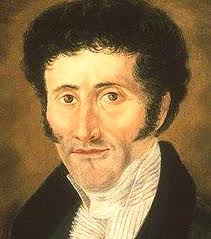
E. T. A. Hoffmann
One doesn’t just read, but rather descends, into the tales of Hoffmann. Sir Walter Scott must have agreed when he judged that Hoffmann didn’t need literary criticism as much as he needed medical assistance:
It is impossible to subject tales of this nature [referring to “The Sand-man”] to criticism. They are not the visions of a poetical mind; they are scarcely even the seeming authenticity which the hallucinations of lunacy convey to the patient; they are the feverish dreams of a light-headed patient.
Lunatic he may be, but somehow Hoffmann manages to convey essential truths through his grotesque tales and drawings.

The Nutcracker
In conventional stories, a character has an identity that we learn about as events unfold. Often that identity develops or evolves, but generally, we at least know whom we’re talking about. Supernatural elements, if they appear, may be hard to explain, but we can usually distinguish them from the ordinary. There’s typically some sort of resolution, which gives us a semblance of coherence.
Hoffmann is quite different. Writing two centuries before post-modernism, Hoffmann turns the rules inside out. Neither we as readers, nor the characters, nor, as I suspect, Hoffmann himself, always know whether a given event is real or imagined. Is it an hallucination, a metaphor, a dream, or a supernatural occurrence? Is the kobold we encounter an independent entity, or simply a buried aspect of some character’s personality? Is this one a person, or a doll that the character assumes is alive? Is some occurrence the dream of a character, of Hoffmann, or one that we forgot that we’d been having and now can’t eliminate from our thoughts?
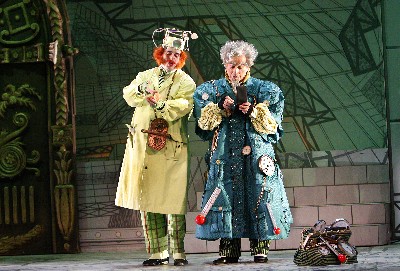
Spalanzani & Coppélius in “Tales of Hoffmann”
Combining rich, believable realism with extravagant fantasy, Hoffmann gets the reader to probe deep into the story, whatever the reader imagines that to be. He challenges Aristotle’s Poetics by offering only the beginning and the middle, but not the end, or resolution: He shows us that it’s a disservice to a good story to bring it to an end; the reader should be allowed to carry it onward.
In one of his best stories, The Golden Flower Pot, We struggle along with Anselmus to make sense of a world that doesn’t make much sense. The Archivarius tells him,
the gold-green snakes, which you saw in the elder-bush, Herr Anselmus, were simply my three daughters; and that you have fallen over head and ears in love with the blue eyes of Serpentina the youngest, is now clear enough.
The elder-bush, then a snake, now becomes the love of his dreams:
The Student Anselmus felt as if he now merely heard in plain words something he had long dreamed of, and though he fancied he observed that elder-bush, wall and sward, and all objects about him were beginning slowly to whirl around, he took heart, and was ready to speak; but the Archivarius prevented him; for sharply pulling the glove from his left hand, and holding the stone of a ring, glittering in strange sparkles and flames before the Student’s eyes, he said: “Look here, Herr Anselmus; what you see may do you good.”
It’s painfully obvious what Anselmus should not do, yet, he does. We as readers follow obediently and disastrously, learning along the way the preposterousness and the tragedy of romanticism from one its major initiators.
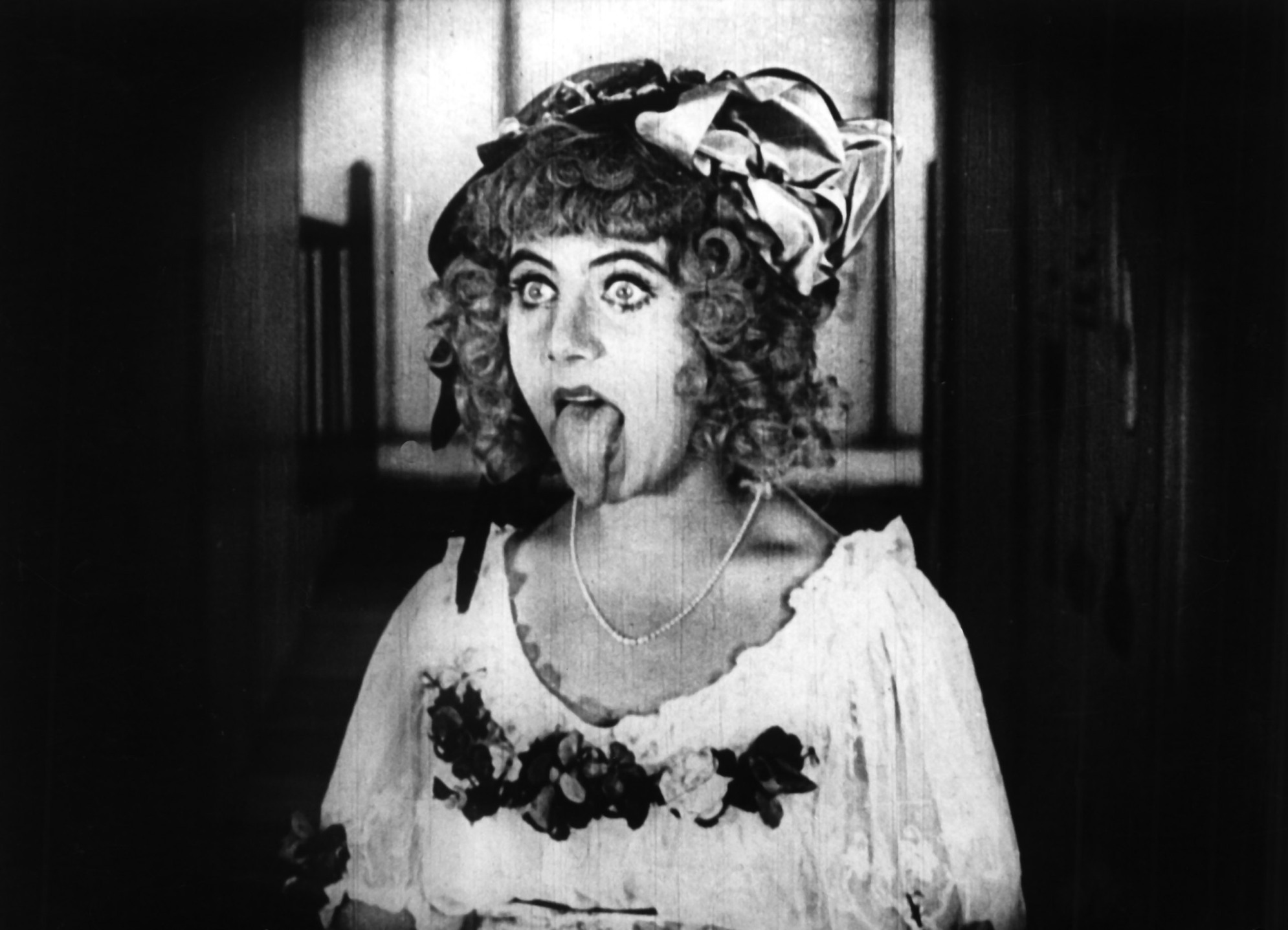
The Doll (DIe Puppe)
Thanks to these features, Hoffmann’s stories invite a variety of interpretations on multiple levels. The nutcracker may be Napoleon and the seven-headed mouse king, his seven cabinet members. But they may also be Hoffmann’s critique of romanticism, or a manifestation of buried aspects of the personalities of Clara and Fritz. Or, maybe they’re just idle fantasies, and Hoffmann has seduced the reader into unveiling his own psychic disturbances.
Ernst Theodore Wihelm Hoffmann is best known by his pen name, E. T. A. Hoffmann (Ernst Theodor Amadeus Hoffmann). But if my experience and that of a few friends is any guide, he’s not known well known by any name today, at least in the US beyond scholars of German romanticism, and certainly not anywhere near what his contributions deserve.
Some people are familiar with Offenbach’s The Tales of Hoffmann, an opera based on Hoffmann’s short stories with him as the main protagonist, or with the Powell and Pressburger film. Fewer still know that Tchaikovsky’s ballet The Nutcracker was inspired by Hoffmann’s “The Nutcracker and the Mouse King.” That may be due to the fact that the sweet Christmas performances of the ballet lack the disturbing edge that Hoffmann works into all of his stories.

Kapellmeister Kreisler
But I didn’t know that Hoffmann’s stories inspired many other famous works of music and film (e.g., Alfred Hitchcock, Bergman’s Fanny and Alexander); that his writings were a major influence on Edgar Allen Poe, Nikolai Gogol, Charles Dickens, Charles Baudelaire, George MacDonald, Fyodor Dostoevsky, Franz Kafka, Jorge Luis Borges, Robertson Davies, Alexandre Dumas, père, and even Sigmund Freud and Carl Jung; that he wrote the first (Western) detective story, a novella (Mademoiselle de Scudéri); that his stories are the basis for much of modern gothic, ghost, sci-fi, and other genres; that he was arguably the first romantic composer in music, inspiring Robert Schumann and others; that his music and literary criticism were major influences on romanticism; or that he was an accomplished sketch artist, political satirist, and philosopher.
Worth getting to know. Just be careful about those dreams.
References
Hoffmann, E. T. A. (1967). The best tales of Hoffmann (edited with an Introduction by E. F. Bleiler). New York: Dover.
Scott, Sir Walter (1827). On the supernatural in fictitious composition. The Foreign Quarterly Review, I(1), 60-98.


 Chip's journey