The school as social center

What did Dewey mean when he imagined the school as social center of the community and as a site for building a democratic society? How is that different from just teaching history and government, or discussing the local newspaper in class? Are there any schools today that realize Dewey’s vision?

Dewey articulated these ideas in an early speech called “The School as Social Center.” He recognized even then that there were dramatic innovations in transportation & communication, the relaxation of social discipline & control, the growing need for knowledge in all affairs of life, and the need for lifelong learning. As a result, he saw the need to change the image of what constitutes citizenship and therefore the image of the purpose of the school. These ideas are developed more in an excellent new book called Dewey’s Dream.

One implication of this perspective is the creation of community schools, many of which are allied through the Coalition for Community Schools. Through that network, individuals and organizations share work on “education K-16, youth development, community planning and development, family support, health and human services, government and philanthropy.”

Other implications are to move beyond elitist models of service and to focus on reflective transformation of ourselves and our own organizations:

the creation of public spaces can be a seedbed for productive, pluralist, citizen-owned politics in an age of gated communities and privatized resources. We need to change the now dominant view of civic learning as community service or service learning, if we are to develop the political sensibilities of our students. Organizing involves understanding education as about transformation, the “reworking” of ourselves and our contexts. An organizing approach is what we need to develop, if we are to think and act politically. (Boyte, 2003)

A project at the Pedro Albizu Campos High School in Chicago is an excellent example of what Dewey meant. It embodies the community school idea, as well as ideas urban agriculture projectof transformation and collaborative inquiry to address community needs. In this case, “seedbed” has a literal meaning as well.
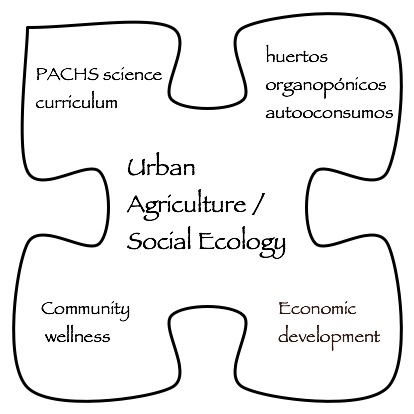
The project (Urban Agriculture in the Context of Social Ecology) began as a way for students to learn science with hands-on investigations of hydroponics and soil-based gardening. It has since expanded to include the study of urban agriculture, community wellness, and economic development. For example, students will grow the ingredients needed for salsa de sofrito, such as tomatoes, onions, garlic, green bell peppers, ajíes dulces, oregano, cilantro, and other spices. Growing these and making the sauce will afford a deeper understanding of their cultural heritage. Bottling and selling the sauce will contribute to community economic development as well as affording an understanding of economics and food processing.

See The Quill greenhouse project in Hartford.

References

Benson, Chris, & Christian, Scott (Eds.) (2002). Writing to make a difference: Classroom projects for community change. Teachers CP. Projects in which young people write for community change.

Benson, Lee, Harkavy, Ira, & Puckett, John. (2007). Dewey’s dream: Universities and democracies in an age of education reform. Philadelphia, PA: Temple University Press.

Boyte, Harry Chatten (2003). A different kind of politics: John Dewey and the meaning of citizenship in the 21st century. The Good Society, 12(2), 1-15.

Dewey, John (1902, October). The school as social center. The Elementary School Teacher, 3(2), 73-86.

Messing about in technology

If we were to establish a hall of fame for reflective writing about teaching, especially for texts revealing deep, yet accessible ideas about pedagogical theory/practice, it would be difficult to find better candidates than “Messing About in Science” by David Hawkins (1965). The paper describes his work in a fifth-grade class teaching about pendulums as part of the Elementary Science Study, which grew out of his discussions with Eleanor Duckworth, another insightful science educator. Although the study was grounded in a specific setting, the ideas might be applied to any subject of study or types of learners, including learning about and with digital technologies.

Phases in science learning

Hawkins identifies three patterns, or phases, of school work in science. These phases induce different relations among children, materials of study, and teachers. If we substitute “mentors” or “colleagues” for “teachers,” we see that they apply fairly well to science work itself and to other kinds of learning and work. That’s not so surprising, given that the essence of the phases is that the form of inquiry in science is not that different from the form of inquiry in learning. In fact, Hawkins prefers the term “work” over “play” in his model, even though it might appear that he’s just arguing for allowing children to have time to play.

Hawkins has in mind the kind of work one might do on a boat, citing the famous passage by in The Wind in the Willows, by Kenneth Grahame (1908):

“Believe me, my young friend”, said the water rat solemnly, “there is nothing…absolutely nothing…half so much worth doing as simply messing about in boats. Simply messing…nothing seems really to matter, that’s the charm of it. Whether you get away or whether you don’t; whether you arrive at your destination or whether you reach somewhere else, or whether you never get anywhere at all, you’re always busy, and you never do anything in particular…”

slipping pennies into water

(Slipping pennies into water in an investigation of surface tension, in a school in Brisbane; note the name tape on the forehead!)

Hawkins discovered that in order to learn in science we need ample time to “mess about.” Because it may appear that we don’t “get anywhere at all,” this phase is often neglected and undervalued. Thus, he devotes most of his article to the circle (◯) or “messing about” phase, in which learners engage in “free and unguided exploratory work” (p. 67).

In the pendulum study, Hawkins had planned to allow the children to explore for an hour or two, before getting into the science lesson per se. But he soon discovered that they needed more time to become familiar with the materials. Moreover, the materials provided a structure to their investigations. Their messing about was far from chaotic or undirected. In fact, as they messed about they began to generate the very questions that the lesson was intended to address, but in a way that was more involved, and connected to their direct experience.

Hawkins goes on to describe two additional phases, which he sees as essential, but more often included in science teaching. The triangle (△) phase, involves “multiply programed material” to support work that is “more externally guided and disciplined” (p. 72). The square (▢) phase is for “discussion, argument, and the full colloquium of children and teacher” (p. 74). The phases are unordered, and all are important. Learning in science requires the opportunity to experience al of the phases in a connected way, and to move easily among them.

Franz and Papert (1988) build on Hawkins’s ideas in a paper about students learning how to measure time. They argue that using computers well for learning requires

open-ended projects that foster students’ involvement with a variety of materials; …activities in which students use computers to solve real problems; …[connection of] the work done on the computer with what goes on during the rest of the school day, and also with the students’ interests outside of school; …[recognizing] the unique qualities of computers; …[taking advantage of] ow-cost technological advances…, which promote integration of the computer with aspects of the students’ physical environment.

Youth community informatics

In our Youth Community Informatics project, middle-school students make podcasts of stories important in their lives. Their work (learning) appears to follow the models we see in the pendulum and time projects, especially in terms of the value of messing about. They need time to explore, experiment, and become comfortable with the technologies.

In the project, young people select images from the web, scan in family photos, create graphics, find and download music, create audio files, edit audio using Audacity, and create presentations. They learn about copyright and citing sources, as well as about design and story-telling. More importantly, they use the podcasts as a way to connect with and talk about their families and their lives outside of school.

Like Hawkins, we see the value of guided inquiry (△) and of full colloquium (▢) in this work, but we have seen increasingly the need for ample time to mess about (◯) as well. Doing that allows students to make the technology part of their lived experience and not something divorced from it.

References

Hawkins, David (1965). Messing about in science. Science and Children, 2(5), 5-9.

Franz, George, & Papert, Seymour (1988, Spring). Computer as material: Messing about with time. Teachers College Record, 89(3), 408-417.